Onboarding A/B Experiment:
Progress Bar Impact
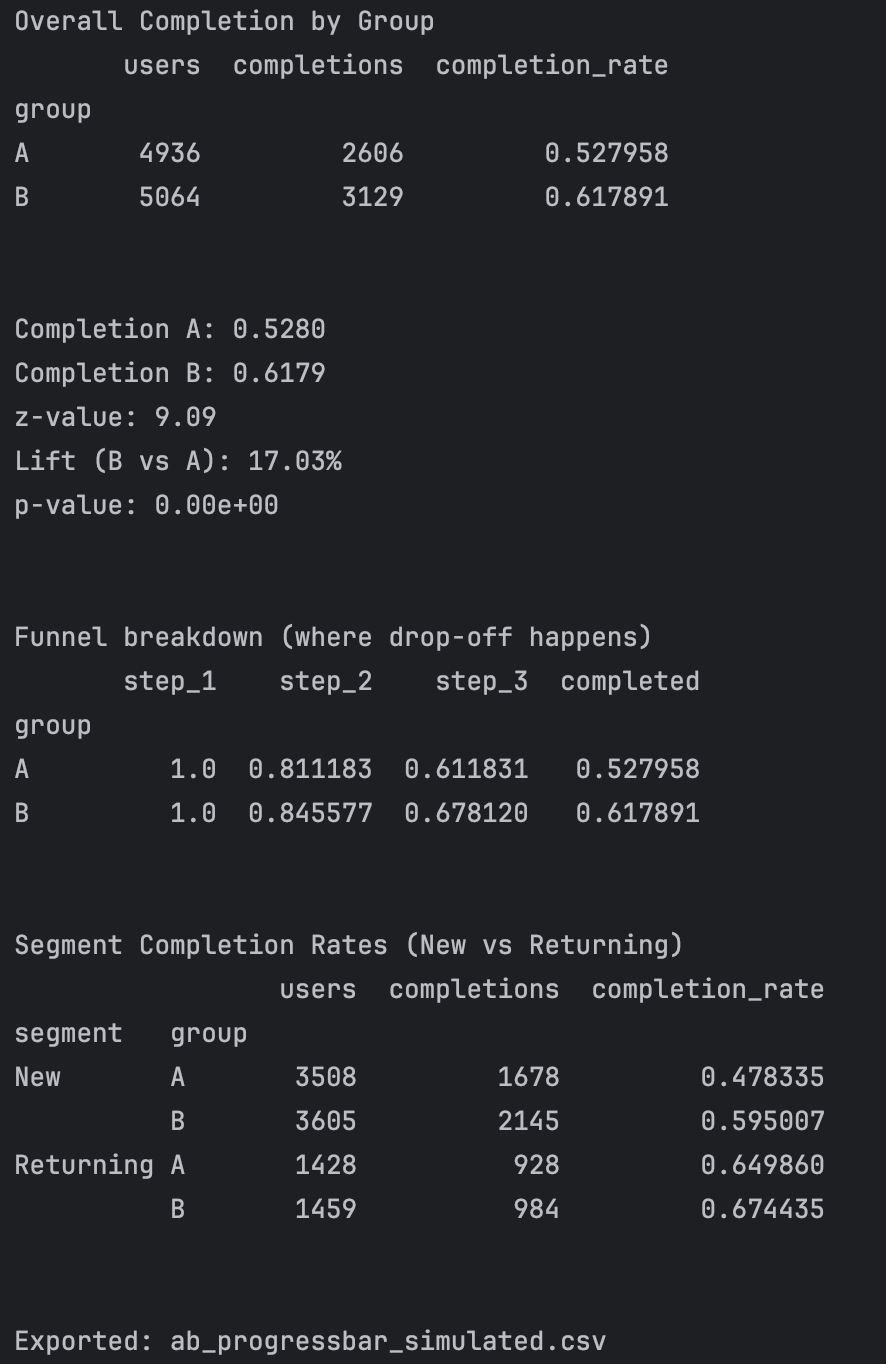
In this project, I designed and executed a simulated A/B experiment in Python to evaluate the impact of a progress bar on user onboarding completion. The goal was to understand whether providing users with clearer progress feedback could reduce drop-off and improve activation.
I modeled an onboarding funnel consisting of multiple sequential steps and randomly assigned 10,000 users to either a control group (no progress bar) or a treatment group (with progress bar). User behavior was simulated using probabilistic transitions to reflect realistic differences between new and returning users.
The analysis focused on:
Overall onboarding completion rates
Step-level funnel drop-off points
Segment-level differences between new and returning users
A two-proportion z-test was used to quantify whether differences in completion rates between the two variants were statistically significant. Results showed a meaningful lift in completion for the treatment group, with the strongest impact observed among new users.
Based on the findings, I proposed a segmented rollout strategy, recommending the progress bar be prioritized for new users to maximize activation gains while maintaining UX efficiency for returning users. This project demonstrates my ability to combine experimentation, statistical reasoning, and product thinking to inform data-driven decisions.