Google Data Analytics Professional Certificate
Google Data Analytics Professional Certificate
Google Data Analytics Professional Certificate
Data & Analytics
A professional certificate covering the full analysis process, from framing the question through cleaning, analyzing, visualizing, and presenting findings to the people who act on them.
A professional certificate covering the full analysis process, from framing the question through cleaning, analyzing, visualizing, and presenting findings to the people who act on them.
A professional certificate covering the full analysis process, from framing the question through cleaning, analyzing, visualizing, and presenting findings to the people who act on them.
Google Data Analytics Professional Certificate
The certificate gave me a foundation in the full data analysis process, from defining a business problem and preparing data through analyzing results and communicating insights. I worked through hands on exercises and case studies covering each stage, and gained experience using SQL, Python, Tableau, Excel, and Google Sheets to clean, organize, analyze, and visualize data. I also learned how to identify trends, validate findings, and present results in a way that is clear and actionable for different audiences. Beyond the technical skills, it reinforced the importance of asking the right questions, maintaining data quality, and documenting work clearly.
Capstone: Bellabeat Marketing Analysis
Bellabeat makes wellness trackers for women and sells a subscription that turns health data into personalized guidance. The task was to study how people use a competitor's smart devices and turn that into a marketing recommendation. I used a public Fitbit dataset covering 33 users across 31 days and ran the analysis in SQL using BigQuery. Instead of activity levels, I looked at which features people keep using. Bellabeat's subscription sells guidance generated from user data, and that only works if users keep producing the data. A feature nobody logs cannot support a paid product no matter how good the guidance is.
What people actually track
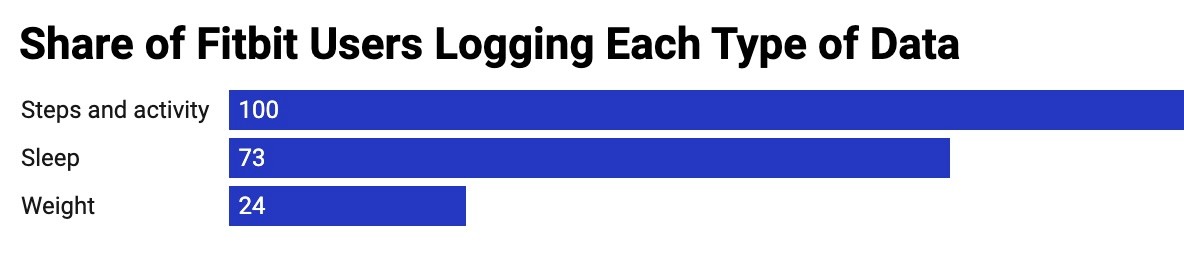
Adoption follows how much effort a feature takes. Steps record themselves. Sleep means wearing the device overnight. Weight means a connected scale or typing a number into an app. All 33 users logged steps, on a median of 31 of the 31 days. 24 logged sleep, on a median of 20 nights. 8 ever logged a weight, on a median of 2 occasions, and of the 67 weight entries in the whole dataset, 41 were typed in by hand. That eliminates two of the three. Steps are universal but every tracker on the market has them, so there is nothing to sell against a competitor. Weight depends on manual entry, and manual entry failed badly enough here that no feature should be built on it. Sleep is the only stream that is both distinctive and sustained by most users. Sleep adoption also splits instead of tapering. Of the 24 who tried it, 9 gave up inside 10 nights and 10 logged 25 or more. Users decide early and then hold, which puts the whole acquisition window in the first two weeks.
A result I did not report
This one is a check on the data rather than part of the marketing case. Sedentary minutes and minutes asleep correlate at -0.60, and that gets repeated as evidence that sedentary people sleep worse. Both come out of the same 1,440 minute day, so an extra hour asleep mechanically removes an hour that could have been logged as sedentary. Expressed as a share of waking hours, the correlation drops to -0.16. I also removed 72 days where the device recorded zero steps and a full 1,440 sedentary minutes, which moves average daily steps from 7,638 to 8,271.
What I recommended
Market the membership on sleep and concentrate onboarding on the first two weeks, since that is when users either commit to overnight tracking or abandon it. Stop asking users to enter anything by hand, since manual logging failed at a rate that makes any feature depending on it unreliable. Before acting on either, use Bellabeat's own data, because this sample has 33 people, no gender field, and one month of history, and it comes from a competitor's device.
Google Data Analytics Professional Certificate
The certificate gave me a foundation in the full data analysis process, from defining a business problem and preparing data through analyzing results and communicating insights. I worked through hands on exercises and case studies covering each stage, and gained experience using SQL, Python, Tableau, Excel, and Google Sheets to clean, organize, analyze, and visualize data. I also learned how to identify trends, validate findings, and present results in a way that is clear and actionable for different audiences. Beyond the technical skills, it reinforced the importance of asking the right questions, maintaining data quality, and documenting work clearly.
Capstone: Bellabeat Marketing Analysis
Bellabeat makes wellness trackers for women and sells a subscription that turns health data into personalized guidance. The task was to study how people use a competitor's smart devices and turn that into a marketing recommendation. I used a public Fitbit dataset covering 33 users across 31 days and ran the analysis in SQL using BigQuery. Instead of activity levels, I looked at which features people keep using. Bellabeat's subscription sells guidance generated from user data, and that only works if users keep producing the data. A feature nobody logs cannot support a paid product no matter how good the guidance is.
What people actually track
Adoption follows how much effort a feature takes. Steps record themselves. Sleep means wearing the device overnight. Weight means a connected scale or typing a number into an app. All 33 users logged steps, on a median of 31 of the 31 days. 24 logged sleep, on a median of 20 nights. 8 ever logged a weight, on a median of 2 occasions, and of the 67 weight entries in the whole dataset, 41 were typed in by hand. That eliminates two of the three. Steps are universal but every tracker on the market has them, so there is nothing to sell against a competitor. Weight depends on manual entry, and manual entry failed badly enough here that no feature should be built on it. Sleep is the only stream that is both distinctive and sustained by most users. Sleep adoption also splits instead of tapering. Of the 24 who tried it, 9 gave up inside 10 nights and 10 logged 25 or more. Users decide early and then hold, which puts the whole acquisition window in the first two weeks.
A result I did not report
This one is a check on the data rather than part of the marketing case. Sedentary minutes and minutes asleep correlate at -0.60, and that gets repeated as evidence that sedentary people sleep worse. Both come out of the same 1,440 minute day, so an extra hour asleep mechanically removes an hour that could have been logged as sedentary. Expressed as a share of waking hours, the correlation drops to -0.16. I also removed 72 days where the device recorded zero steps and a full 1,440 sedentary minutes, which moves average daily steps from 7,638 to 8,271.
What I recommended
Market the membership on sleep and concentrate onboarding on the first two weeks, since that is when users either commit to overnight tracking or abandon it. Stop asking users to enter anything by hand, since manual logging failed at a rate that makes any feature depending on it unreliable. Before acting on either, use Bellabeat's own data, because this sample has 33 people, no gender field, and one month of history, and it comes from a competitor's device.
Google Data Analytics Professional Certificate
The certificate gave me a foundation in the full data analysis process, from defining a business problem and preparing data through analyzing results and communicating insights. I worked through hands on exercises and case studies covering each stage, and gained experience using SQL, Python, Tableau, Excel, and Google Sheets to clean, organize, analyze, and visualize data. I also learned how to identify trends, validate findings, and present results in a way that is clear and actionable for different audiences. Beyond the technical skills, it reinforced the importance of asking the right questions, maintaining data quality, and documenting work clearly.
Capstone: Bellabeat Marketing Analysis
Bellabeat makes wellness trackers for women and sells a subscription that turns health data into personalized guidance. The task was to study how people use a competitor's smart devices and turn that into a marketing recommendation. I used a public Fitbit dataset covering 33 users across 31 days and ran the analysis in SQL using BigQuery. Instead of activity levels, I looked at which features people keep using. Bellabeat's subscription sells guidance generated from user data, and that only works if users keep producing the data. A feature nobody logs cannot support a paid product no matter how good the guidance is.
What people actually track
Adoption follows how much effort a feature takes. Steps record themselves. Sleep means wearing the device overnight. Weight means a connected scale or typing a number into an app. All 33 users logged steps, on a median of 31 of the 31 days. 24 logged sleep, on a median of 20 nights. 8 ever logged a weight, on a median of 2 occasions, and of the 67 weight entries in the whole dataset, 41 were typed in by hand. That eliminates two of the three. Steps are universal but every tracker on the market has them, so there is nothing to sell against a competitor. Weight depends on manual entry, and manual entry failed badly enough here that no feature should be built on it. Sleep is the only stream that is both distinctive and sustained by most users. Sleep adoption also splits instead of tapering. Of the 24 who tried it, 9 gave up inside 10 nights and 10 logged 25 or more. Users decide early and then hold, which puts the whole acquisition window in the first two weeks.
A result I did not report
This one is a check on the data rather than part of the marketing case. Sedentary minutes and minutes asleep correlate at -0.60, and that gets repeated as evidence that sedentary people sleep worse. Both come out of the same 1,440 minute day, so an extra hour asleep mechanically removes an hour that could have been logged as sedentary. Expressed as a share of waking hours, the correlation drops to -0.16. I also removed 72 days where the device recorded zero steps and a full 1,440 sedentary minutes, which moves average daily steps from 7,638 to 8,271.
What I recommended
Market the membership on sleep and concentrate onboarding on the first two weeks, since that is when users either commit to overnight tracking or abandon it. Stop asking users to enter anything by hand, since manual logging failed at a rate that makes any feature depending on it unreliable. Before acting on either, use Bellabeat's own data, because this sample has 33 people, no gender field, and one month of history, and it comes from a competitor's device.