Uber Customer Sentiment Analysis
Uber Customer Sentiment Analysis
Uber Customer Sentiment Analysis
Data & Analytics
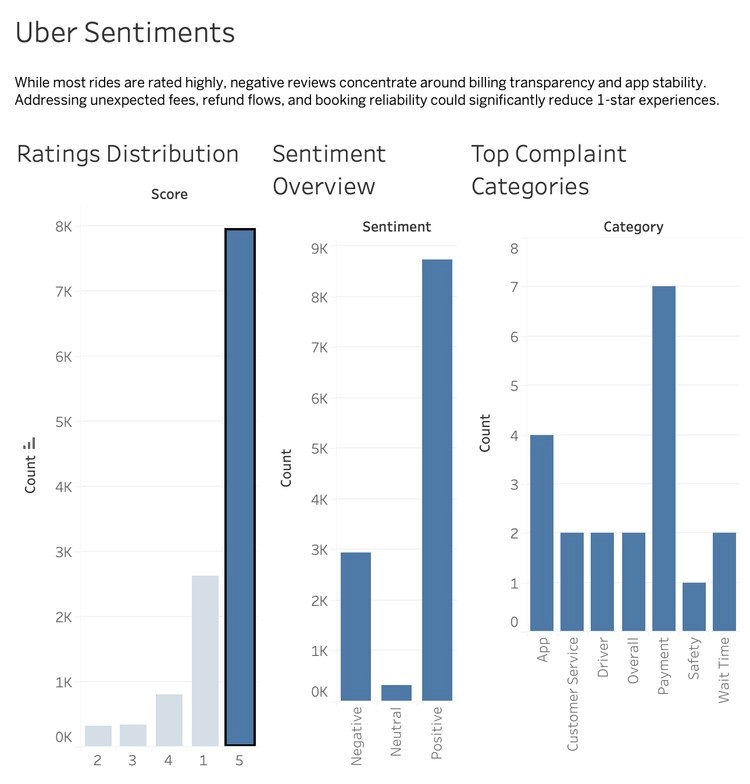
Across more than 12,000 app reviews the ratings are polarized rather than mediocre. One star is the second most common score, and payment issues lead every complaint category.
Across more than 12,000 app reviews the ratings are polarized rather than mediocre. One star is the second most common score, and payment issues lead every complaint category.
Across more than 12,000 app reviews the ratings are polarized rather than mediocre. One star is the second most common score, and payment issues lead every complaint category.
The problem
App store reviews are the largest and least usable source of feedback most consumer products have. Twelve thousand of them is too many to read and too many to ignore, and a star average tells you people are unhappy without telling you what to fix.
Approach
I cleaned and aggregated the raw review text in Excel, then classified each review by feature area, including payments, app performance, driver experience, safety, and wait time, and by sentiment. I built the dashboard in Tableau. With both dimensions in place I could stop asking which topics came up most and start asking which ones were over represented in one and two star reviews.
The finding I would lead with
Five star reviews dominate, but one star is the next largest group, bigger than two, three, and four star reviews put together. That is a polarized experience rather than an average one, and it matters because the fix is different. An app with a lot of three star reviews has a quality problem spread thinly. An app with a heavy one star tail has specific failures happening to specific people. The sentiment split runs roughly 8,700 positive, 2,900 negative, and 400 neutral, which reinforces the same shape.
Where the complaints sit
Sorting the negative reviews by category, payments came out well ahead of everything else, with app performance second. Safety appeared least often, which is worth saying plainly because it is the category people assume will dominate.
Recommendations
I turned the findings into a prioritized set of fixes focused on billing clarity, refund flows, and booking stability, on the grounds that unexpected fees and failed bookings are the two things most likely to produce a one star review rather than a three star one.
The problem
App store reviews are the largest and least usable source of feedback most consumer products have. Twelve thousand of them is too many to read and too many to ignore, and a star average tells you people are unhappy without telling you what to fix.
Approach
I cleaned and aggregated the raw review text in Excel, then classified each review by feature area, including payments, app performance, driver experience, safety, and wait time, and by sentiment. I built the dashboard in Tableau. With both dimensions in place I could stop asking which topics came up most and start asking which ones were over represented in one and two star reviews.
The finding I would lead with
Five star reviews dominate, but one star is the next largest group, bigger than two, three, and four star reviews put together. That is a polarized experience rather than an average one, and it matters because the fix is different. An app with a lot of three star reviews has a quality problem spread thinly. An app with a heavy one star tail has specific failures happening to specific people. The sentiment split runs roughly 8,700 positive, 2,900 negative, and 400 neutral, which reinforces the same shape.
Where the complaints sit
Sorting the negative reviews by category, payments came out well ahead of everything else, with app performance second. Safety appeared least often, which is worth saying plainly because it is the category people assume will dominate.
Recommendations
I turned the findings into a prioritized set of fixes focused on billing clarity, refund flows, and booking stability, on the grounds that unexpected fees and failed bookings are the two things most likely to produce a one star review rather than a three star one.
The problem
App store reviews are the largest and least usable source of feedback most consumer products have. Twelve thousand of them is too many to read and too many to ignore, and a star average tells you people are unhappy without telling you what to fix.
Approach
I cleaned and aggregated the raw review text in Excel, then classified each review by feature area, including payments, app performance, driver experience, safety, and wait time, and by sentiment. I built the dashboard in Tableau. With both dimensions in place I could stop asking which topics came up most and start asking which ones were over represented in one and two star reviews.
The finding I would lead with
Five star reviews dominate, but one star is the next largest group, bigger than two, three, and four star reviews put together. That is a polarized experience rather than an average one, and it matters because the fix is different. An app with a lot of three star reviews has a quality problem spread thinly. An app with a heavy one star tail has specific failures happening to specific people. The sentiment split runs roughly 8,700 positive, 2,900 negative, and 400 neutral, which reinforces the same shape.
Where the complaints sit
Sorting the negative reviews by category, payments came out well ahead of everything else, with app performance second. Safety appeared least often, which is worth saying plainly because it is the category people assume will dominate.
Recommendations
I turned the findings into a prioritized set of fixes focused on billing clarity, refund flows, and booking stability, on the grounds that unexpected fees and failed bookings are the two things most likely to produce a one star review rather than a three star one.